 Back to All Posts


Posted June 01, 2026
Long Before AI: BNA’s Habit of Looking Ahead
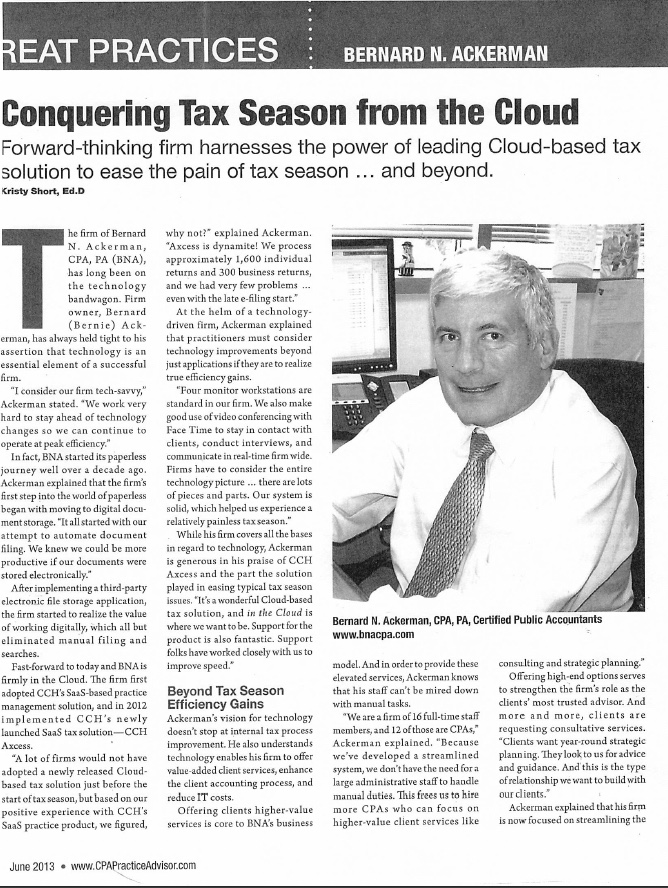
In 2013, CPA Practice Advisor published an article about BNA CPAs & Advisors titled Conquering Tax Season from the Cloud. The piece highlighted the firm’s early adoption of cloud based tax systems, paperless workflows, and digital collaboration tools, ideas that still felt relatively new to much of the accounting profession at the time.
Reading it today feels a little strange because so many of the things described in it have since become completely normal.
Cloud hosted software. Remote access. Digital document storage. Streamlined workflows. Virtual communication.
Today, those ideas barely register as innovative.
The more interesting part of the story is this: BNA was not thinking this way because technology was trendy. The firm had already developed a habit of looking ahead and questioning how things could work better.
The tools changed. The mindset did not.
Asking Better Questions
Long before AI became the latest industry obsession, BNA kept asking the same question:
Is there a better way to do this?
Sometimes that meant adopting new technology earlier than other firms. Sometimes it meant changing internal processes before it felt comfortable. And sometimes it simply meant refusing to accept that “this is how accounting firms have always done it” was a good enough reason to stay stagnant.
The 2013 article described BNA’s move toward paperless systems and cloud infrastructure as part of an effort to simplify operations during tax season. But underneath the technical details was something more fundamental: the belief that technology should reduce friction, both for employees and for clients.
“We work very hard to stay ahead of technology changes so we can continue to operate at peak efficiency.”
— Bernard “Bernie” Ackerman, CPA Practice Advisor, 2013
That philosophy has remained consistent at BNA for decades.
Even today, as firms race to implement AI tools and automation platforms, the firms navigating change most successfully are often not the ones adopting every new tool the fastest.
The real challenge is using technology intentionally without losing sight of the people at the center of the work.
At BNA, that means continuing to focus on what has always mattered most: helping clients clearly, thoughtfully, and efficiently.
“BNA is committed to staying ahead of the curve, consistently serving as an early adopter and beta tester who collaborates directly with development teams to help improve the technology we use for our clients.”
— Trey Schnippel, Chief Operating Officer
Technology Changed Client Expectations
There is also another layer to this story that feels easy to overlook now.
Technology did not just change accounting workflows. It changed client expectations.
Clients no longer want to wait days for documents to move back and forth. They expect visibility. Accessibility. Faster communication. Easier collaboration. More proactive guidance.
In many ways, the profession itself evolved around those expectations, and BNA evolved alongside it.
The article noted that technology allowed the firm to streamline repetitive administrative work and spend more time on higher value advisory services. That shift away from purely transactional work and toward deeper client relationships quietly reshaped much of the accounting profession over the last decade.
And BNA was already talking about it in 2013.
“We’ve developed a streamlined system, so we don’t have the need for a large administrative staff to handle manual duties. This frees us to hire more CPAs who can focus on higher value client services like consulting and strategic planning.”
— Bernard “Bernie” Ackerman, CPA Practice Advisor, 2013
More Time for What Matters
What makes that quote stand out now is not just the operational efficiency behind it. It is the philosophy underneath it.
The goal was never to make the firm feel less human.
It was the opposite.
Remove enough unnecessary friction, and people have more time to think, advise, communicate, and solve problems.
That idea still drives many of the conversations happening inside the firm today.
Looking back, the technology described in the 2013 article is no longer groundbreaking.
But the mindset behind it still feels remarkably current.
Stay curious. Stay adaptable. Do not get too comfortable. Keep looking ahead.
Or, as Bernie put it more than a decade ago:
“It’s the way the profession is moving.”
— Bernard “Bernie” Ackerman, 2013
